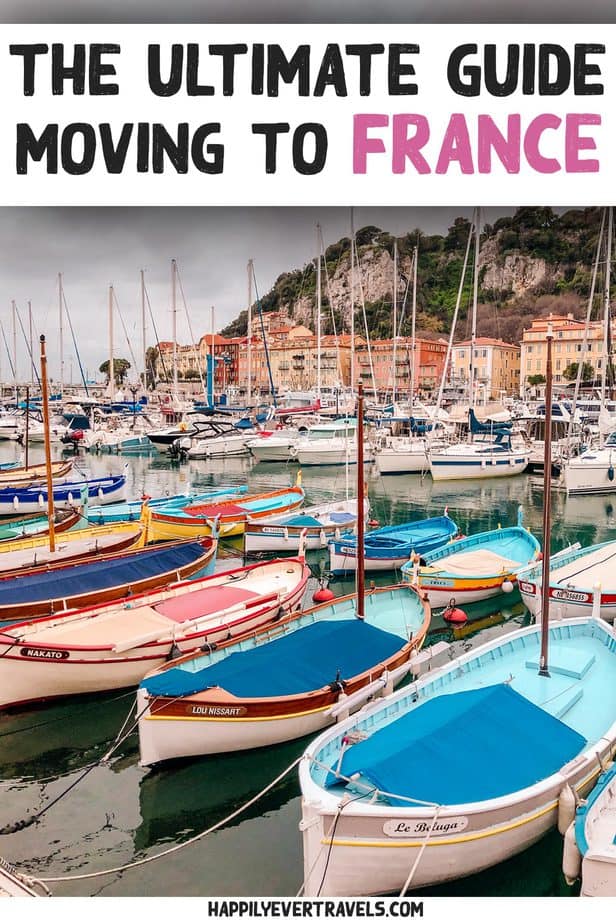
Updated October 2026. When I first wrote this guide in 2020, French visas in the US went through a company called VFS Global. Since April 18, 2025, a different company, TLScontact, handles them, and several fees and rules have changed since then too. I've rewritten this guide for the current process and kept our own story where it still helps. Visa rules change often, so always double-check fees and requirements on France-Visas before you pay for anything. I'm not a lawyer, just someone who has been through this twice.
This might sound crazy, but when I opened up my passport, after all the hard work that went into this process, and I saw a beautiful full-page Long Stay France Visa inside, I started sobbing. Tears of actual joy.
I love my husband and everything, but I didn't even cry on our wedding day!
As many will tell you, this process is not for the faint of heart. It takes a ridiculous amount of paperwork, every document that you've ever received from the government, and a little bit of luck.
But if I'm being even more honest, it was easier than I thought it would be. We applied from Los Angeles in 2019 and again in 2021, and both times it went smoothly. So with that paradox in mind, I think we're ready to do this!
The Short Version: What You Need to Know in 2026
- Who processes applications: TLScontact, since April 18, 2025. You apply online on France-Visas, then book an in-person appointment with TLScontact.
- Where: TLScontact has 10 centers in the US: Atlanta, Boston, Chicago, Houston, Los Angeles, Miami, New York, San Francisco, Seattle and Washington DC.
- Visa fee: €99 for a long-stay visa, charged in US dollars. TLScontact also charges its own service fee. Neither is refunded if your visa is refused.
- Money: For one person, France's benchmark is €1,477.93 net a month (€17,735.19 a year), which is the French minimum wage (SMIC) as of June 2026.
- Health insurance: It has to cover your whole stay.
- Work: You can't work in France on this visa.
- After you arrive: You validate your visa online within 3 months of arriving and pay a validation tax. ANEF shows the current amount when you validate.
- Renewing: You apply online between 4 and 2 months before your visa or card expires.
What Visa Do You Need?
This guide is for people applying for the Long Stay Visitor Visa, or Visa de Long Séjour Visiteur. It's the visa for people who want to live in France for a year and can support themselves without working in France.
If you are applying for a student visa, a talent visa, or a work visa, some of this will still apply to you, but the specific requirements for each visa are different.
Financial Requirements
This visa has financial requirements, and they're the part people worry about most. France expects you to be able to provide for yourself for a FULL YEAR without working in France.
The official benchmark is the French minimum wage. According to Service-Public, the French government's information site, the minimum for a single person is €1,477.93 net a month, or €17,735.19 over a year. That number goes up when the minimum wage goes up, so check it again when you apply.
I have a whole post that goes over the financial requirements in more detail.
Here's what we did. When we applied in 2019, we had $32,000 in our savings account. We were worried that wouldn't be enough, so we also had a guarantor and paystubs, and we showed about $40,000 in available credit (you add up the credit limits on all of your credit cards to get this number).
(P.S. If you don't know what a host or a guarantor is yet, don't worry, we'll go over those in detail later.)
I also have a friend who only had $9,000 in savings but was able to prove that he makes over $3,000 a month from his online job (using paystubs), and he had a guarantor and a host. So he had enough to show he could cover his expenses.
I can't tell you a magic number beyond the official benchmark. All I can tell you is to do EVERYTHING you can to look good on paper.
Can You Work Remotely on This Visa?
This is a gray area. The official rule on Service-Public is: "Do not work in France whether as an employee, trader, self-entrepreneur, craftsman, liberal profession etc." You'll also sign a statement promising not to work in France.
What that means for remote work for a US employer or US clients isn't spelled out on that page. When we applied, I said in my application that I would be teaching online for VIPKID and writing for this blog, and they still gave me the visa. You cannot have ANY French clients or ANY money coming from a job in France.
That was our experience, not legal advice. If your plan depends on working remotely, talk to an immigration lawyer before you apply.
How Early Should You Start?
The application itself isn't that difficult. Once you have your host, guarantor and insurance lined up, it should only take a couple of weeks to get everything together.
France-Visas recommends booking your appointment at least a month before you leave for a long stay. Give yourself more time than that if you can.
Should You Buy Tickets to France Before Applying?
This is up to you. Jake and I decided that we were going to go to France whether we got the visa or not. We didn't want to wait until we had the visa because that would only have left us a few weeks to buy tickets.
We use Skyscanner to find cheap flights, so as soon as I saw a deal, I jumped on it. Plus, we could show our exact arrival date and our tickets at the appointment, which strengthened our application.
Passport Requirements
Your passport needs blank pages for the visa and must not expire during your stay. Your France-Visas checklist will list the exact rules, so check your passport against it before you start. You might need to renew your passport first.
Pro Tip: If you travel a lot, ask for the larger 50-page passport book instead of the standard 26-page one, so you don't run out of pages. Heads up: the State Department plans to replace both sizes with a single 38-page book when it redesigns the passport, expected in 2028.
Where Do You Apply?
You won't go to the French consulate. France outsources visa appointments to a private company, and since April 18, 2025, that company in the US is TLScontact.
TLScontact has application centers in:
- Atlanta
- Boston
- Chicago
- Houston
- Los Angeles
- Miami
- New York
- San Francisco
- Seattle
- Washington DC
Each center can have slightly different requirements, but the basics are the same. We'll go over the documents later in this post, including the ones I'd bring "just in case."
Want to say 'thank you'? Buy me a coffee! (:
Do You Need to Apply in Person?
Yes. You need to go to your appointment in person, which is a hassle (and expensive) if you don't live near one of those cities. The good news is you only need to go once.
According to France-Visas, passports are returned by registered mail, except in Washington DC. Check your center's page on TLScontact for how that works and what it costs.
So now that we've covered the basics, let's go through the actual steps!
Step 1: Make a France-Visas Account
First, go to the official France-Visas website and create an account. You'll get an email to verify it, and then you can log in.
If you are applying for more than one person, you only need one account. In that account, you can create a group application for up to 10 people.
Step 2: Fill Out the Online Application
The form asks for your passport details, your address, your job, and your travel plans. Most of it is straightforward. A few parts matter more for this visa:
Your Plans
Choose a long stay (more than 90 days) and the Visitor purpose, and pick the TLScontact center you plan to go to.
For the length of stay, I chose "Between 6 months and 1 year" and got the 1-year visitor visa. Others have reported needing to choose "More than 1 year." Either way, I said clearly in my letters that I wanted the 1-year visa, so make sure to include that in yours.
Press "Save" often. The site can log you out, and anything you haven't saved is lost.
Your Information
You'll need your Social Security Number for this part. The application calls it your "National Identity Number."
You'll also describe your current job here. This matters later, when you show that you have enough money to live in France.
Your Stay
This is where you put your date of arrival in France. We put the 5th but then ended up buying tickets for the 12th, and at our appointment they just had us change the date on the printed form.
If you're applying with your spouse or family, say "yes" when it asks if you're traveling with family members and fill in their details.
Your Accommodation or Host
This section is for where you'll live and how you'll pay for your stay. It's totally okay not to know the answers yet. You can save your application, get what you need, and come back.
What they want to see is that you have somewhere to live and won't be a burden on France. For Los Angeles, we didn't need a signed lease ahead of time. I've written a whole post about the accommodation proof you need for the visa.
One option is to book a place for the whole year with a good refund policy. I didn't want to risk losing that money, so I booked one full month on Airbnb (non-refundable) and decided that even if we didn't get the visa, we'd spend a month in Nice anyway.
A host is a person who lives legally in France (or is a French citizen) and puts in writing that you can stay with them. A host can really strengthen your application, because it shows you'll have a place to live. Only use a host if the arrangement is real: you're making a statement to the French government.
Your host will need to give you:
- A copy of their French ID or residence card (front and back)
- Their lease or proof that they own their home in France
- A recent utility bill in their name
- A letter saying you'll be staying with them (see Step 7)
- Their address
If you don't know anyone in France, Facebook groups for Americans living in France are a good place to start. Use the search bar in those groups to find answers to your questions, and get to know people before you ask anyone for a favor this big.
Paying for Your Stay: Yourself
Check the box that you'll be funding your own stay, and check every way you'll prove it: savings and checking statements, paystubs, a pre-booked place to stay, your plane ticket if you have one, and credit card limits.
Paying for Your Stay: A Guarantor
A guarantor is someone who commits in writing to support you financially if you can't support yourself while you're in France. Only ask someone who could actually do that and understands what they're signing.
We asked Jake's mom. We're lucky to have someone we could ask, and we know that isn't easy for a lot of people. It doesn't need to be a parent, just an adult who trusts you and has the means.
We had our guarantor commit to a monthly amount. Today I'd make sure that amount is at least the €1,477.93 benchmark from above.
They will need to give you:
- A copy of their ID (front and back)
- 3 months of bank statements
- 3 months of paystubs
- A letter stating how much they commit to send you each month (see Step 7)
Review and Submit
When you've filled everything in, you'll get a summary page to check before you submit. Do your best to get it right the first time so your application looks clean.
After that, France-Visas shows you the list of supporting documents to bring and the visa fee. The long-stay visa fee is €99, charged in US dollars. Hold on to that document list, but know that it isn't everything you'll want to bring. We'll go over the full list below.
Step 3: Book Your TLScontact Appointment
Now you book your in-person appointment on the TLScontact website. This is a separate website from France-Visas, so you'll create a separate account there.
Choose your center, pick a date and time, and pay TLScontact's service fee. The fee varies by center, so check it on the site. Save and print your appointment confirmation.
A little history: the old VFS website was famously slow, and I spent a lot of time waiting for pages to load. TLScontact took over after our applications, so I can't tell you what it's like to use, but the tips below still apply.
Pro Tip: Book a morning appointment if you can, and leave time after it in case they tell you that you're missing something. That way you can run and print it before the center closes.
Step 4: Print Your Application
Log back in to France-Visas and download your completed application form and its document checklist. This form IS your application, and the checklist is what they'll use at your appointment to make sure you have everything.
Sign and date the form for the day of your appointment.
Step 5: Get Your Documents Ready
Alright! Now it's time to print, print, print. I suggest making a folder on your computer named "France Visa Documents," because it gets hard to keep track of everything.
Here is the list of everything we brought. Put things in the order of the checklist from your application. I've marked the ones that were extras.
You don't need two copies of everything, but we brought two for both Jake and me. It was a lot, but in some cases it paid off.
The Full List
The basics:
- TLScontact appointment confirmation
- Your France-Visas application form (signed and dated for the day of your appointment)
- The document checklist from the end of your application
- Your valid passport
- A copy of your passport ID page
- A copy of your birth certificate
- A copy of your marriage certificate (if married)
- Passport photos (check your checklist for the number and size)
Purpose of your stay:
- A signed statement that you won't work in France (Service-Public asks for a handwritten one)
- A letter from your employer or proof of your income
- 3 months of paystubs (EXTRA)
Health insurance:
- A copy of your insurance card
- Your insurance confirmation of coverage letter
Accommodation:
- Your Airbnb or hotel receipt
- Letter from your host (if you use one)
- Your host's ID, front and back (if you use one)
- Your host's lease or deed (if you use one)
Money:
- A letter explaining your finances
- 3 months of savings account statements (include ALL pages, not just the first one)
- 3 months of checking account statements (or whichever account your income goes into)
- Credit card statements showing your credit limit (EXTRA)
Your guarantor:
- Letter from your guarantor
- Their ID (front and back)
- 3 months of their bank statements
- 3 months of their paystubs
Other:
- A credit card to pay the visa fee at your appointment
- A copy of your Social Security card (EXTRA)
- A copy of your driver's license (EXTRA)
Do You Need a Background Check?
No. At your appointment, you hand in your documents and then go into a small room to have your fingerprints and photo taken. They call it "biometrics." So no expensive background check, and no waiting for one to come back in the mail. Yay!
Step 6: Get Health Insurance
Health insurance is the one thing you'll actually need to buy before your appointment.
The official requirement on Service-Public is health insurance "covering the duration of your stay." Look for a plan made for this visa and make sure its confirmation letter says clearly what it covers and for how long. You'll often see €30,000 of coverage mentioned. That's France's official minimum for short-stay visas, and many people use it as the benchmark for long stays too.
Both times we applied, we used a Patriot International plan from Insubuy, and it was accepted. I still use Insubuy today. Prices and plans change, so compare a few quotes and check the refund terms in case your visa is refused.
After you pay, you'll get your insurance ID card and confirmation letter, which you need for your application. We bought coverage for the full year, since the visa is for the full year.
Step 7: Write the Letters
You may have noticed that the document list includes quite a few letters: a letter explaining your finances, a letter from your host, a letter from your guarantor, and your statement that you won't work in France.
When I applied, friends sent me templates to follow, and they made the process SO much simpler. Write yours clearly, sign and date them, and say in each one that you're applying for the 1-year long-stay visitor visa.
Step 8: Print Everything and Get Organized
Alright, now it's time to print. They want a LOT of paper. If you have a printer at home, that's definitely the cheapest option.
When we applied in LA, we were missing a document and I had to print it at the last second at the nearest place I could find. They charged me almost $7 to print five pages on an ancient computer. So come as prepared as you can, but know there's usually a backup.
At your appointment, they'll go down the checklist from your application and check things off. It's fine to have extra documents as long as the basics are in order. If you print second copies, keep them separate so they're ready if they ask, but not mixed into your main stack.
A plain manila folder is perfect for keeping it all together.
And if you read all of this, you're definitely disciplined enough to get this visa! Bonne chance!
Want to say 'thank you'? Buy me a coffee! (:
What to Do After You Get Your Visa
You're not done yet! Once you arrive in France, you have 3 months to validate your visa online. You do this on the French government's foreigners' website, administration-etrangers-en-france.interieur.gouv.fr, often called ANEF.
You'll also pay a tax when you validate. ANEF shows the current amount for your visa when you validate, so go by that rather than a number from a blog post.
Renewing Your Long-Stay Visa
If you want to stay longer than your visa, you apply for a residence card (carte de séjour) online on ANEF. According to Service-Public, you apply at the earliest 4 months and at the latest 2 months before your visa or card expires. Applying late adds a €180 fee.
The tax is paid with tax stamps: Service-Public lists €350 for a first visitor card and €250 for a renewal. ANEF will tell you which applies to you. When I renewed in October 2026, I paid €250.
I'm still renewing my visa every year. Here in Nice, the process is almost entirely online, which was super convenient. All I had to do was get my bank statements translated.
I used Bilingual Minds for my translations, because I could upload my documents to their website and got them back within a few days, on paper or digitally. I've used them for our birth certificates, marriage certificate, and bank statements, and they were all accepted.
The last thing I needed was a photo from a Photomaton, those little photo booths you see all over France. Choose the option for official ID photos that comes with a code, because you'll type that code into your application. We found one in a Monoprix. Don't smile, and tuck your hair behind your ears, out of your face.
More Posts About France
- Our Crazy Story of Finding an Apartment in France
- Pros and Cons of Living in France
- France Visa Documents Checklist
- Things to Do in Èze
- A Walking Map of Menton's Best Photo Spots
There's a ton of information here, don't forget to pin this so you can find it later!! (: